The best pruning shears for most home gardeners are bypass hand pruners sized to your hand, with a hardened steel blade you can resharpen and parts you can replace. The Felco 2 fits that description for large hands, the Felco 6 for medium and smaller hands, and the Corona ClassicCUT BP 3180D covers the same job with an all-steel build. Gardeners with a weak grip should look at a geared pruner instead.
Last updated: November 2026. This guide is research-based. Specifications come from manufacturer and retailer product pages, and the cutting advice comes from university extension publications. No product was tested for this page.
Quick picks: seven hand pruners compared
Every pick below is a bypass pruner, because that is the design extension horticulturists recommend for live stems. Rated capacity is the maker’s or retailer’s maximum, not a comfortable everyday cut. See the capacity rule further down before you choose by that number alone.
| Pruner | Best for | Rated cut capacity | Key strength | Main limitation | Link |
|---|---|---|---|---|---|
| Felco 2 | Large hands, heavy seasonal use | 0.98 in | Every wear part is replaceable | Right-hand only, sized for large hands | View on Amazon |
| Felco 6 | Medium and small hands, roses | 0.79 in | Compact, angled cutting head | Lower capacity than the Felco 2 | View on Amazon |
| Corona ClassicCUT BP 3180D | Thick stems on a tighter budget | 1 in | Forged steel, resharpenable blade | Steel handles weigh more than aluminum | View on Amazon |
| Fiskars Bypass Pruner | Light trimming, first pruner | 5/8 in | Works in either hand, lifetime warranty | Smallest capacity in this list | View on Amazon |
| Fiskars PowerGear2 | Weak grip, arthritis | 3/4 in | Gearing multiplies hand force | More moving parts than a plain pruner | View on Amazon |
| Okatsune 104 | Large hands, gardeners who want a simple tool | About 1 in (25 mm, retailer figure) | Forged Japanese steel, very few parts | No cushioning or adjustment features | View on Amazon |
| Corona FlexDIAL BP 4214D | Households sharing one pruner | 3/4 in | 8-position dial sets the grip to hand size | No published weight or parts list | View on Amazon |
How we researched this
This page is built from documents, not from a workbench. We read five competing roundups to see which models keep appearing and what those pages leave out. We then opened nine manufacturer or retailer product pages to confirm each specification quoted here, and three university extension publications for the cutting and capacity guidance. The research was done in November 2026.
A spec appears on this page only if it was printed on a product page we opened. Where a figure could not be confirmed, the table says so instead of filling the gap. We did not analyze buyer reviews for this edition, so you will not find review counts, ratings or quoted customer opinions here.
The capacity rule most roundups skip
Buy pruning shears for the cut you make every week, not for the biggest cut printed on the package. That one rule removes most buyer regret.
Makers rate these tools at 5/8 inch to 1 inch. Extension guidance is more conservative. Iowa State University Extension’s pruning equipment guide puts the working limit for hand pruners at 3/4 inch, hands branches from 3/4 inch to 1 1/2 inches to loppers, and sends anything larger to a pruning saw. LSU AgCenter’s hand pruner article draws the same 3/4 inch line.
Put the two numbers side by side and you get a simple headroom figure: rated capacity minus the 3/4 inch working limit. A pruner with positive headroom is not straining on a normal cut. A pruner with zero or negative headroom is a light-duty tool, whatever the packaging suggests.
| Pruner | Rated capacity | Extension working limit | Headroom | What that means |
|---|---|---|---|---|
| Corona ClassicCUT BP 3180D | 1 in | 3/4 in | +1/4 in | Comfortable on woody shrub stems |
| Okatsune 104 | about 1 in | 3/4 in | about +1/4 in | Comfortable on woody shrub stems |
| Felco 2 | 0.98 in | 3/4 in | about +1/4 in | Comfortable on woody shrub stems |
| Felco 6 | 0.79 in | 3/4 in | near zero | Fine for roses, perennials, young wood |
| Fiskars PowerGear2 | 3/4 in | 3/4 in | zero | Use at its limit only on green wood |
| Corona FlexDIAL BP 4214D | 3/4 in | 3/4 in | zero | Garden shrubs and perennials, not thick wood |
| Fiskars Bypass Pruner | 5/8 in | 3/4 in | -1/8 in | Flowers, herbs, soft new growth |
The headroom column is our own arithmetic from the published figures. It is a planning aid, not a measured result.
If you regularly meet stems thicker than a finger, the right second tool is a lopper, not a bigger hand pruner. Forcing a hand pruner through oversized wood is how blades twist out of line.
Fit your hand before you compare features
A pruner that is too big opens wider than your fingers can comfortably reach, so every cut starts from a stretched grip. A pruner that is too small leaves power unused. Size comes first, features second.
Felco is the only maker in this list that publishes a hand-length range for each model. Its product pages list the Felco 2 as a Large tool, for hands 7 7/8 inches or longer, and the Felco 6 as a Medium tool, for hands from 6 7/8 to 7 7/8 inches. Those ranges are a useful yardstick even if you buy another brand.
| Your hand length | Start with | Why |
|---|---|---|
| Under 6 7/8 in | Felco 6, Fiskars Bypass Pruner, Corona FlexDIAL on a low setting | Shorter tools or a reduced opening |
| 6 7/8 to 7 7/8 in | Felco 6, Corona FlexDIAL BP 4214D | Mid-size tool, or a dial you set to your grip |
| 7 7/8 in or more | Felco 2, Corona ClassicCUT BP 3180D, Okatsune 104 | Full-size tools with a wide opening |
| Any size, weak grip | Fiskars PowerGear2 | Gearing does part of the work |
Left-handed gardeners have fewer choices. The Felco 2 and Felco 6 are right-hand tools. The Fiskars Bypass Pruner is described by its retailer as usable in either hand, which makes it the simple answer in this list. Felco also sells dedicated left-hand models, which are worth a look if you want the same repairable design.
The seven picks in detail
Felco 2: best pruning shears for large hands and heavy use

The Felco 2 is the model other bypass pruners get measured against, and the reason is repairability. Felco’s product page lists it at 8.46 inches long and 0.55 pounds, with a hardened steel cutting blade, forged aluminum handles and a rated cutting diameter of 0.98 inch.
The same page describes cushioned shock absorbers that soften the closing action and a micrometric adjustment for setting blade tension. Blades, springs and other components are sold separately, and Felco gives a lifetime warranty on the forged aluminum parts. It is made in Switzerland.
Best suited for: gardeners with large hands who prune roses, fruit trees and shrubs every season and would rather replace a blade than replace the tool.
Skip it if: your hand is under about 7 7/8 inches long, or you are left-handed. The warranty also covers the handles, not the blade, so the blade is a consumable you will eventually buy.
Ownership notes: plan on a new blade and spring over the years rather than a new pruner. That only pays off if you keep the edge maintained, so read our guide on how to sharpen pruning shears before the first season ends.
Felco 6: best for medium and small hands
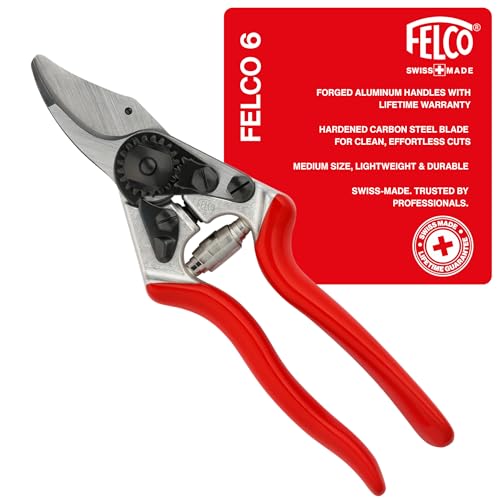
The Felco 6 keeps the same construction in a smaller frame. Felco lists it at 7.68 inches long and 0.48 pounds, with a 1.65 inch blade and a cutting capacity of 0.79 inch. The cutting head is angled so the blade lines up with the hand and wrist.
It shares the cushioned stop, the micrometric adjustment, the replaceable parts and the handle warranty of the larger model.
Best suited for: medium and smaller hands, rose pruning, perennials and the thinner wood on young fruit trees.
Skip it if: much of your pruning is mature shrub wood near 3/4 inch. The headroom table shows this model working close to its limit there, and the Felco 2 or the Corona is the better match.
Ownership notes: the same parts-and-sharpening logic applies. A small-handed gardener who buys the Felco 2 because it is the famous one often ends up with a tool that feels awkward, so trust the hand measurement.
Corona ClassicCUT BP 3180D: best all-steel workhorse

The Corona ClassicCUT BP 3180D is the pick for gardeners who want 1 inch rated capacity without paying for Swiss aluminum. Retail listings describe a forged, high-carbon steel blade that can be resharpened, a 2.75 inch blade length, full steel core handles and non-slip grips. One arborist supplier’s listing also notes that replacement parts are available.
Best suited for: thicker woody stems, general yard cleanup, and anyone who is hard on tools.
Skip it if: weight matters to you. Steel handles are heavier than forged aluminum, and we could not confirm an official weight for this model. It also lacks the published hand-size guidance Felco provides, and its 1 inch capacity implies a wide opening that suits larger hands.
Ownership notes: high-carbon steel takes a keen edge but rusts if it is put away wet or sticky. Wipe it down after use and follow our steps on how to clean and disinfect pruners.
Fiskars Bypass Pruner: best starter pruner for light work
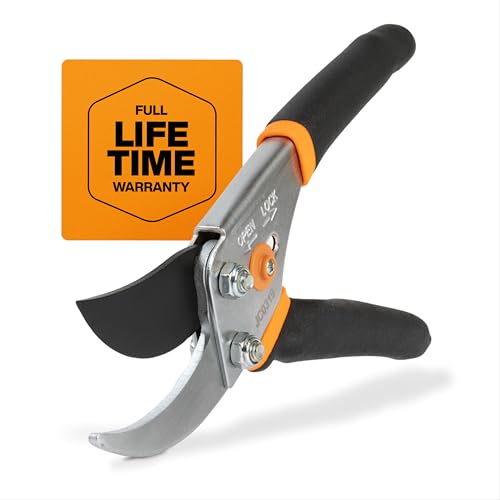
This is the basic orange-and-black Fiskars found in most garden centers. The retailer page we opened describes a fully hardened, precision-ground steel blade with a low-friction coating that resists rust and sap buildup, a 2 inch blade, a non-slip grip that works in either hand, and a full lifetime warranty from the manufacturer. Rated capacity is 5/8 inch.
Best suited for: deadheading, cutting flowers, herbs, tomato suckers and soft new growth. It is a sensible first pruner and a good spare to keep by the back door.
Skip it if: you prune woody shrubs or fruit trees. With negative headroom in our table, it is a light-duty tool. We also found no sign of a replaceable blade for this model, so treat it as a tool you maintain and eventually replace rather than rebuild.
Ownership notes: the coating helps with sap, but coated blades still need sharpening on the beveled side. One retailer spec table lists 0.5 inch rather than 5/8 inch, so do not count on the top figure.
Fiskars PowerGear2: best pruning shears for weak hands

The PowerGear2 changes the mechanics rather than the blade. The listing for model 391041-1001 claims up to 3.2 times more cutting power through gear-multiplied leverage, and describes a contoured lower handle that rolls with the fingers as the hand closes. The blade is fully hardened steel with a low-friction coating, rated for 3/4 inch cuts, and the tool has an easy-open lock.
Best suited for: gardeners with arthritis, reduced grip strength or small hands that tire quickly. Our roundup of the best garden tools for arthritic hands covers more options built on the same idea.
Skip it if: you want the simplest possible tool. Gears and a rolling handle add parts that collect grit, and some gardeners dislike a handle that moves. The power figure is the maker’s claim, not something we measured.
Ownership notes: rinse and dry the gear area after sappy work, and put a drop of oil on the pivot. Fiskars sells several PowerGear2 variants, so check that the listing matches the 3/4 inch bypass model before buying.
Okatsune 104: best simple pruner for large hands
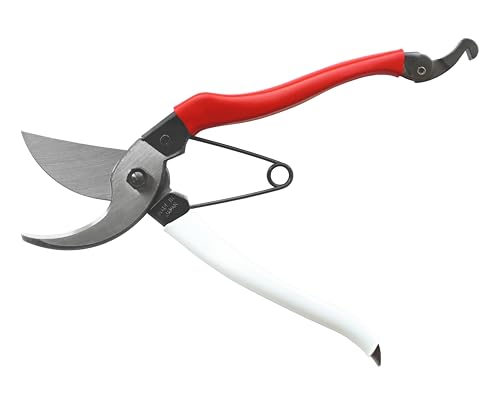
The Okatsune 104 takes the opposite approach to the PowerGear2: forged steel blades, a spring and very little else. One specialist retailer lists it at 8.27 inches (about 210 mm) overall with a 2.16 inch blade, describes it as forged from Japanese steel and designed for large hands, and says it cuts branches up to 25 mm, which is just under 1 inch. Published weights differ slightly between sellers, at 8.3 and 8.6 ounces.
Best suited for: gardeners with large hands who value a keen edge and a tool with almost nothing to go wrong.
Skip it if: you want a shock absorber, a tension adjuster or published hand-size ranges. Hard steel holds an edge well but can chip if you twist it in a cut or use it on wire. The same retailer’s spec list shows a conflicting capacity figure, so treat 25 mm as the seller’s claim.
Ownership notes: dry and oil the blades after use, as with any carbon steel tool. We could not confirm from the pages we opened which replacement parts are sold for the 104, so check before you count on rebuilding it.
Corona FlexDIAL BP 4214D: best adjustable pruner for shared use
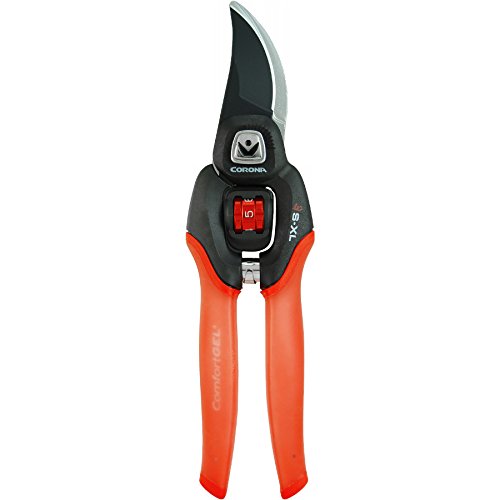
The FlexDIAL solves the fit problem with a dial instead of a size chart. Corona’s product page describes an 8-position adjustment: setting 1 suits smaller hands and quicker cuts, and setting 8 suits larger hands and a more powerful cut. One pruner can then be set for different people in the same household.
The same page lists a coated, non-stick high-carbon steel blade, full steel construction, gel grips that cushion each cut, a 3/4 inch cut capacity and a lifetime warranty against defects in material and workmanship.
Best suited for: households that share one pruner, gardeners between hand sizes, and general shrub and perennial work up to 3/4 inch.
Skip it if: you want maximum capacity or a tool you can strip and rebuild. Corona’s page does not state the weight or list replacement parts, and the headroom table puts this model at zero.
Ownership notes: the warranty requires the original proof of purchase, so keep the receipt. The non-stick coating slows sap buildup but the edge still needs sharpening.
How to pick the best pruning shears: a three-question rule
Answer three questions in order and stop at the first match.
- Is your grip weak or painful? Choose the Fiskars PowerGear2.
- Is most of your cutting soft growth under 1/2 inch? Choose the Fiskars Bypass Pruner and put the savings toward a lopper.
- Do you prune woody plants every season? Measure your hand. Large hands: Felco 2, or the Corona ClassicCUT BP 3180D if you prefer all-steel. Large hands that prefer a simpler tool: Okatsune 104. Medium or small hands: Felco 6. Several people sharing one pruner: Corona FlexDIAL BP 4214D.
No single model wins for everyone. A Felco 2 in a small hand is a worse tool than a basic Fiskars that fits.
What to look for in bypass pruners
Bypass, anvil or ratchet
Bypass pruners cut like scissors, with a sharpened blade sliding past a hook. Iowa State’s guide says they are generally preferred because they make close, clean cuts. Anvil pruners press a blade onto a flat plate and are useful on dead wood. Our comparison of bypass vs anvil pruners explains when the second type earns a place in the shed.
Blade steel and coatings
Hardened and high-carbon steels can be resharpened many times but rust if neglected. Low-friction coatings, like the one on the Fiskars models, reduce sap sticking. A coating does not replace sharpening.
Replaceable parts
This is the biggest long-term difference between the picks. Felco sells blades, springs and small hardware for both models here. One listing for the Corona ClassicCUT mentions replacement parts. We could not confirm parts for the FlexDIAL or the Okatsune 104. For the basic Fiskars we found no replacement blade, which is reasonable for a starter tool.
Handles and weight
Forged aluminum handles keep weight down. Steel handles are tough but heavier. If you make hundreds of cuts in a session, an ounce or two matters more than any feature.
Lock and spring
A thumb lock near the pivot can be worked with one hand. A clasp at the end of the handles is simpler but slower. Springs wear out on every design, so check that a replacement exists.
Care that makes hand pruners last
Three habits protect any of these tools: wipe the sap off after each session, dry the blade before storing it, and touch up the edge when cuts start to tear. A dull blade crushes tissue even on a premium pruner.
If you move between diseased and healthy plants, disinfect the blades. University of Minnesota Extension suggests rubbing alcohol of 70 percent or higher for hand pruners and warns that bleach pits sharp blades. For a wider look at cutting tools beyond hand pruners, see our overview of garden hand cutting tools.
Frequently asked questions
Are pruning shears, hand pruners and secateurs the same thing?
Yes. Pruning shears and hand pruners are the common American terms, and secateurs is the British one. All three describe a one-handed cutting tool for stems up to roughly 3/4 inch.
Are bypass pruners better than anvil pruners?
For live stems, bypass pruners are the usual recommendation because they cut closer and cleaner. Anvil pruners are handy for dead, dry wood and are less likely to jam.
How thick a branch can pruning shears cut?
Extension guidance sets the practical limit at about 3/4 inch, even though some models are rated to 1 inch. Above that, use loppers up to about 1 1/2 inches and a pruning saw beyond that.
How do I maintain my pruning shears?
Clean off sap and soil after use, dry the tool, oil the pivot and spring, and sharpen the beveled side of the blade when cuts stop being clean. Replace worn springs and blades where the maker sells them.
What should I prune in the fall?
Fall is mainly for removing dead, damaged or diseased wood and for cutting back spent perennials. Hold major shaping of trees and spring-flowering shrubs until the timing recommended for that plant by your state extension service.
Final recommendation
Start with fit and workload. For regular woody pruning, the Felco 2 (large hands) and Felco 6 (medium and small hands) offer the clearest long-term value because every wear part can be replaced. The Corona ClassicCUT BP 3180D gives similar capacity in steel. The Fiskars PowerGear2 is the answer for a weak grip, and the basic Fiskars Bypass Pruner is enough for flowers and soft growth.