Quick Answer
The best drip irrigation kits are the ones whose emitter style matches how your plants are arranged. For a single 4 by 8 foot vegetable bed, the Rain Bird GARDENKIT is the closest fit because it is built around quarter-inch emitter tubing with a dripper every 6 inches. For shrubs, borders and mixed plantings, the DIG GE200 and the Rain Bird LNDDRIPKIT give you separate drippers you place plant by plant. For pots and hanging baskets, the Raindrip R560DP adds a faucet timer.
No single garden drip kit suits every yard. Before you compare brands, count your plants or beds, then check that your faucet can supply the kit’s total flow. The flow table below does that arithmetic for each pick.
How We Researched This
This is a research-based comparison. Nothing here was bought, installed or run for this article. In November 2026 we read 16 sources: 7 manufacturer or retailer specification pages, 4 published roundups that rank for this search, 4 university extension guides and 1 retailer help article. A kit made the list only if a specification page or a detailed published review could be opened for it. Where a maker does not publish a number, the tables say “not stated” instead of guessing. Kit contents change between production runs, so confirm the parts list on the product page before ordering.
Quick Picks: Best Drip Irrigation Kits by Garden Type
| Kit | Best For | Key Strength | Main Limitation | Link |
|---|---|---|---|---|
| Rain Bird GARDENKIT | One raised bed up to 4 x 8 ft | 35 ft of emitter tubing with drippers every 6 inches | Maker says not to extend it with extra tubing | View on Amazon |
| DIG GE200 | Mixed beds and borders up to about 700 sq ft | 200 ft of half-inch tubing plus backflow preventer and regulator | No timer in the box | View on Amazon |
| Rain Bird LNDDRIPKIT | Shrubs, perennials and a few larger plants | Three device types: drippers, micro bubblers, micro sprays | Rated for about 22 plants | View on Amazon |
| Raindrip R560DP | Up to 20 pots or hanging baskets | Faucet timer included | Low total flow, small plants only | View on Amazon |
| Garden In Minutes Garden Grid | Square-foot style raised beds | Arrives in pre-assembled sections, no regulator needed | Each grid fits one bed size | View on Amazon |
| Vego Garden Irrigation Kit | Vego and similar metal beds | Metal nozzles with a shutoff on each | Few published specs | View on Amazon |
Which Type of Drip Irrigation System Fits Your Layout?
Start with plant arrangement, because that decides the emitter style. Brand comes second.
- Plants packed close together in a bed (lettuce, carrots, onions, bush beans): use emitter tubing or a grid so the whole bed gets wet evenly. Picks: Rain Bird GARDENKIT, Garden Grid.
- Individual plants with gaps between them (tomatoes, peppers, shrubs, roses): use point-source drippers, one or two per plant. Picks: DIG GE200, Rain Bird LNDDRIPKIT.
- Containers and baskets: use low-flow drippers on quarter-inch tubing, one per pot, and a timer because pots dry fast. Pick: Raindrip R560DP.
- Groundcover or densely planted flower beds: micro sprays or bubblers cover an area instead of a point. Pick: DIG GE200.
Colorado State University Extension notes that micro sprays and drip emitters should sit on separate zones because they put out water at very different rates. A kit that mixes both, such as the GE200, works best if you group the sprayers on one branch you can shut off. See CSU Extension’s drip irrigation guide for home gardens for the full reasoning.
If the terms are new, our explainer on how drip irrigation works covers each part from faucet to emitter.
Flow Budget: Will Your Faucet Run the Kit?
Every kit has a total flow, which is the sum of all its emitters running at once. Your faucet has to supply at least that much. None of the roundups we read put these numbers side by side, so here they are.
| Kit | Emitters in the box | Total flow if all are used | Fits a half-inch line limit of about 200 GPH? |
|---|---|---|---|
| Rain Bird GARDENKIT | 70 inline emitters | About 35 GPH if each is 0.5 GPH (rate from a third-party listing, not stated on Rain Bird’s store page) | Yes |
| DIG GE200 | 20 drippers at 1 GPH, 11 micro sprayers at 14 GPH | 174 GPH (maker’s figure) | Yes, with little room to add more |
| Rain Bird LNDDRIPKIT | 10 drippers at 1 GPH, 10 at 2 GPH, 2 bubblers, 4 micro sprays | 30 GPH from drippers, plus up to 13 GPH per bubbler; spray flow not stated | Yes |
| Raindrip R560DP | 20 drippers at 0.5 GPH | 10 GPH | Yes |
| Garden Grid 4 x 4 | Grid of perforated tubes | 60 to 66 GPH at moderate stream (maker lists 1.0 to 1.1 GPM) | Yes |
| Garden Grid 4 x 8 | Grid of perforated tubes | 120 to 135 GPH at moderate stream (maker lists 2 to 2.25 GPM) | Yes for one grid, not for two on one line |
GPH means gallons per hour. The Garden Grid figures are converted from the maker’s gallons per minute by multiplying by 60.
How to check your faucet in two minutes
CSU Extension describes a bucket test: open an outdoor faucet fully, time how long it takes to fill a bucket of known size, divide gallons by seconds and multiply by 3,600. A 5 gallon bucket that fills in 60 seconds means 300 GPH. CSU suggests planning on about 75 percent of that, so 225 GPH of usable flow.
In that example every kit above fits. A slow faucet that takes two minutes to fill the same bucket gives 150 GPH, or about 112 GPH usable. That rules out running all 31 devices of the DIG GE200 at once and makes a two-zone layout the better plan.
How long to run a bed kit
Utah State University Extension gives a handy conversion: one inch of water over one square foot is 0.623 gallons. A 4 by 8 foot bed is 32 square feet, so one inch of water is about 20 gallons.
| Bed kit | Flow on a 4 x 8 ft bed | Time to apply about 1 inch (20 gallons) |
|---|---|---|
| Rain Bird GARDENKIT (assuming 0.5 GPH emitters) | 35 GPH | About 34 minutes |
| Garden Grid 4 x 8 at moderate stream | 120 to 135 GPH | About 9 to 10 minutes |
These are calculations from published flow figures, not measured results. Treat them as a starting point, then check soil moisture at root depth the day after watering and adjust, which is the method CSU Extension recommends. The USU conversion comes from its do-it-yourself guide to backyard drip irrigation.
The 6 Kits in Detail
1. Rain Bird GARDENKIT Raised Bed Garden Kit

Best suited for: one raised bed up to 4 by 8 feet planted with vegetables or annuals.
Rain Bird’s store page lists 35 feet of quarter-inch emitter tubing with 70 pressure-compensating emitters spaced every 6 inches, 25 feet of plain quarter-inch distribution tubing, 10 each of barbed fittings, elbows, plugs and stakes, a faucet adapter, a 25 psi regulator and a filter washer. That is enough tubing for four 8 foot runs across a 4 foot wide bed with a little left over.
Why it earned a place: closely spaced inline emitters suit the tight plant spacing of a vegetable bed, and the regulator and filter washer are in the box, so there is no separate head assembly to source.
Real limitations: Rain Bird states plainly that the kit should not be extended with extra tubing because flow becomes reduced or uneven. To water a second bed, the maker’s advice is a second kit on a Y splitter or another faucet. The store page does not state the flow per emitter, and no timer or backflow preventer appears in the parts list.
Skip it if: you have three or more beds, or beds longer than 8 feet. A half-inch mainline system will cost less per bed and balance better.
2. DIG GE200 Drip and Micro Sprinkler Kit

Best suited for: a mixed garden with shrubs, perennials and some groundcover, up to roughly 700 square feet according to DIG.
DIG’s cut sheet lists 200 feet of half-inch poly tubing, 50 feet of quarter-inch micro tubing, 20 pressure-compensating drippers at 1 GPH, 11 micro sprayers (three full-circle, four half-circle, four quarter-circle), a backflow preventer, a 25 psi preset regulator, a swivel adapter with screen, tees, elbows, stakes, plugs and a hole punch. Operating pressure is 25 to 30 psi and the stated maximum incoming pressure is 100 psi.
Why it earned a place: it is the only kit on this list whose published parts list includes a backflow preventer, and the 200 feet of mainline matches the run length CSU Extension gives as the limit for a single half-inch zone.
Real limitations: the kit’s total flow is 174 GPH against DIG’s recommended maximum of 220 GPH, so there is little headroom for extra emitters. There is no timer. The parts list shows a screen in the swivel adapter and no separate filter.
Skip it if: you only have a single small bed or a handful of pots. Most of the tubing would go unused.
3. Rain Bird LNDDRIPKIT Landscape and Garden Drip Watering Kit
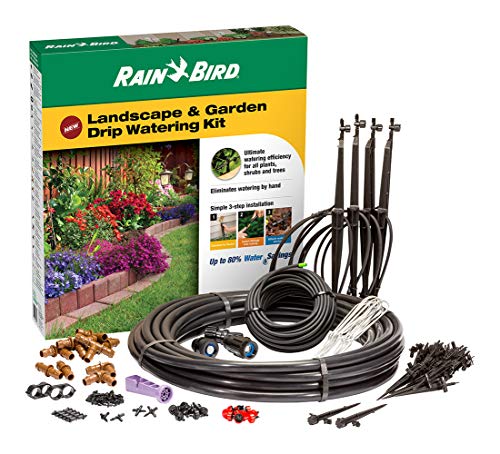
Best suited for: a planted border or a row of shrubs where plants differ in size.
Rain Bird lists 50 feet of half-inch distribution tubing, 50 feet of quarter-inch tubing, 10 drippers at 1 GPH, 10 at 2 GPH, two adjustable micro bubblers, four adjustable micro sprays, a faucet connection and a pressure regulator. The maker’s spec table says it waters up to 22 plants.
Why it earned a place: two dripper sizes let you give a larger shrub twice the water of a small perennial on the same line, and the bubblers handle a thirsty plant or a large container.
Real limitations: the page does not state the regulator’s pressure or mention a filter. The description and the spec table disagree on plant count (26 versus 22) and on piece count (108 versus 109). Fifty feet of mainline is short for anything beyond one border.
Skip it if: you are watering a densely sown vegetable bed. Twenty drippers cannot wet a full bed evenly.
4. Raindrip R560DP Automatic Watering Kit
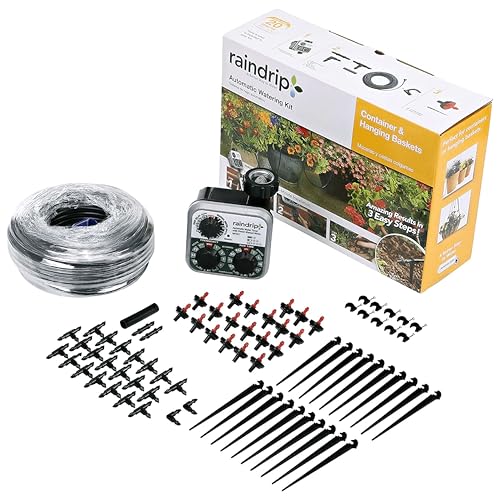
Best suited for: a patio with up to 20 containers or hanging baskets.
A retailer listing for the R560DP shows a faucet timer, 20 drippers at 0.5 GPH, 20 dripper stakes, 20 tees, supply tubing, connectors, elbows and clamps. Bob Vila’s review puts the tubing at 75 feet and notes the kit is not designed to expand.
Why it earned a place: containers need frequent, short watering, and this is the only pick here with a timer in the box.
Real limitations: at 10 GPH in total, it is a small-plant kit. The listing we opened does not mention a pressure regulator, filter or backflow preventer, so check the box contents. Each pot gets the same 0.5 GPH regardless of size.
Skip it if: your pots vary a lot in size, or you want to add in-ground beds later.
5. Garden In Minutes Garden Grid

Best suited for: raised beds planted in a square-foot pattern, and buyers who do not want to cut tubing.
The Garden Grid is a rigid grid of tubes that sits on the soil and doubles as a planting guide. The maker says it ships in pre-assembled sections, connects to a standard garden hose, includes a filter screen, needs no pressure regulator and works down to about 10 psi. Sizes run from 1 by 3 feet to 4 by 8 feet. It is not a classic drip system: flow is adjusted from a slow drip to a full stream at the faucet or with a valve.
Why it earned a place: it removes the layout step entirely for a rectangular bed, and its high flow means short run times.
Real limitations: each grid fits one bed size with very little adjustment. The maker recommends its separately sold manifold for beds taller than 12 inches or when linking several grids. In hard-water areas the maker suggests brushing off mineral buildup every year or two. The Amazon link below is for the 2 by 4 foot size, so pick your size on the listing.
Skip it if: your beds are round, oddly shaped or planted in long rows. We look at this product more closely in our Garden Grid watering system review.
6. Vego Garden Irrigation Kit

Best suited for: owners of Vego or similar corrugated metal beds who want the plumbing on the bed rim.
Published specifications are thin. Bob Vila’s review describes metal nozzles with adjustable sprayers, a manual shutoff on each nozzle, operation on household pressure up to 80 psi, and the option to chain up to four large beds on one line.
Why it earned a place: per-nozzle shutoffs are rare in kits and useful when half a bed is empty between crops.
Real limitations: the nozzles spray, so some foliage gets wet, which gives up part of the disease benefit of true drip. We could not open a maker page with a parts list, tubing length or emitter count; two published sources give different tubing lengths.
Skip it if: you want low-pressure drippers under mulch.
What Comes in the Box: Head Assembly Compared
The head assembly is the stack of parts between the faucet and the tubing. University of Illinois Extension lists a backflow preventer, a filter and a pressure reducer as the core parts, and Clemson Extension adds the timer at the faucet. Kits differ a lot here, and missing parts are an extra purchase.
| Kit | Timer | Backflow preventer | Filter | Pressure regulator |
|---|---|---|---|---|
| Rain Bird GARDENKIT | No | Not listed | Filter washer | 25 psi |
| DIG GE200 | No | Yes | Screen in swivel adapter | 25 psi preset |
| Rain Bird LNDDRIPKIT | No | Not listed | Not mentioned | Yes, pressure not stated |
| Raindrip R560DP | Yes | Not listed | Not listed | Not listed |
| Garden Grid | No | Not listed | Built-in screen | Maker says not needed |
| Vego Garden Irrigation Kit | Not stated | Not stated | Not stated | Runs on household pressure per Bob Vila |
“Not listed” means the part did not appear on the page we read. It may still be in the box.
Buying Criteria That Matter
Pressure regulation
Household pressure is far higher than drip parts are built for. CSU Extension puts typical static supply at 50 to 70 psi and drip regulators at roughly 20 to 30 psi. A kit without a regulator needs one added, unless the maker says otherwise as Garden In Minutes does.
Filtration
Emitter openings are tiny, and grit clogs them. CSU Extension recommends a 150 to 200 mesh filter for municipal water. Clemson Extension calls a filter a must on well water. A filter washer is the minimum, and a proper screen filter is a cheap upgrade.
Pressure-compensating emitters
Pressure-compensating drippers hold their rated flow along the line, so the last plant gets about the same water as the first. The GARDENKIT and GE200 both list them.
Tubing limits
Drip Depot’s help center gives two rules of thumb: half-inch tubing handles about 200 feet per run and 200 GPH, and quarter-inch tubing about 30 feet and 30 GPH. A kit that asks more of its tubing than that will water unevenly. Our guide on how to plan a drip irrigation layout shows how to apply those limits to a real yard.
Expandability
Half-inch mainline kits (DIG GE200, Rain Bird LNDDRIPKIT) accept standard fittings and extra drippers until you hit the flow limit. Quarter-inch-only kits and rigid grids are fixed in size.
Long-term upkeep
Plan on rinsing the filter several times a season and draining the system before a freeze. Illinois Extension advises bringing the backflow preventer, filter and pressure reducer indoors for winter. Drippers and tubing are consumables: budget for a few replacements each year. See Illinois Extension’s home garden drip article for the winter routine.
Who Should Not Buy a Drip Kit at All
- Lawns and large seeded areas. Drip waters points and lines, not turf.
- Very large trees. CSU Extension says trees that mature above 25 feet are generally impractical to water with drip.
- Gardeners who replant the whole layout every few weeks. A soaker hose is quicker to move. Our article on garden hoses with holes for watering covers that option.
- Anyone unsure which watering method they need. Start with the wider comparison of garden watering systems.
Frequently Asked Questions
How much water does a drip irrigation system use?
It depends on the emitters. A system’s use per hour is the sum of its emitter ratings, so 20 drippers at 1 GPH use 20 gallons per hour. Illinois Extension reports drip uses roughly 30 to 50 percent less water than sprinklers because 90 to 95 percent of it soaks in.
Should drip irrigation tubing be buried?
Standard drip tubing is laid on the surface and covered with mulch. CSU Extension recommends mulch over the tubing and wire stakes every 2 to 3 feet, which hides the lines and removes the trip hazard while keeping emitters reachable.
Can a drip irrigation system go uphill?
Yes, within limits. CSU Extension’s rule is to add 5 psi of operating pressure for every 10 feet of rise above the water connection. On slopes, UC Master Gardeners advise laying tubing across the slope instead of up and down it.
Do I need a pressure regulator with a drip kit?
In most cases yes. Drip parts are designed for roughly 10 to 30 psi and home supply is usually well above that. The exception is a product whose maker states it runs at household pressure.
Can I connect a drip kit to a hose timer?
Yes. Clemson Extension places the timer directly on the spigot, followed by the regulator and filter. Any kit above can sit behind a hose-end timer.
Next Step
Count beds, plants and pots, run the bucket test, then pick the emitter style from the layout list above. If this is your first system, read the drip irrigation mistakes beginners make before you cut any tubing. If you are still choosing beds, our raised garden bed guide covers sizes that suit standard kits.