The best cedar raised garden beds are the kits with the thickest boards you can afford, because board thickness and joinery decide how long a wooden bed holds its shape. For most yards that means a 4 x 8 ft kit with boards around 3/4 in thick, such as the Greenes Fence Premium Cedar bed, or a 1 in thick western red cedar kit such as the Infinite Cedar Premium if you want the bed to stay in place for many seasons. Kits with 1/2 in boards cost less up front but are the first to bow and rot.
This page covers cedar raised bed kits only: species, board thickness, corner joints, finish, height and expected life. If you are still choosing between wood, metal, fabric and plastic, start with the wider guide to the best raised garden beds across all materials.
Quick picks: cedar raised bed kits by buyer type
| Kit | Best for | Key strength | Main limitation | Link |
|---|---|---|---|---|
| Greenes Fence Premium Cedar 4 x 8 | Most first-time wood bed buyers | 3/4 in boards, tool-free dovetail corners, stackable | Sliding joints rely on the corner posts staying sound | View on Amazon |
| Infinite Cedar Premium 3 x 6 x 11 in | Buyers who want the thickest kit boards | Full 1 in western red cedar, bolted corners | Needs bolting together; smaller footprint | View on Amazon |
| Infinite Cedar Select 4 x 8 x 17.5 in | Deep-rooted crops, less bending | 17.5 in of height in western red cedar | Boards are 11/16 in, thinner than the Premium line | View on Amazon |
| Greenes Fence Cedar U-Shaped 8 x 8 | Large plots with reach from the middle | Walk-in layout, 3/4 in boards | Needs a level 8 x 8 ft area and a lot of soil | View on Amazon |
| Greenes Fence Original Cedar Elevated 48 x 24 x 31 | Patios, decks, gardeners who cannot kneel | 31 in working height, fabric liner included | About 9.6 in of soil depth, 6.3 cu ft | View on Amazon |
| Greenes Fence Classic Cedar 4 x 8 | Short-term or trial gardens | Lowest board cost in a real cedar kit | 1/2 in boards, shortest expected life here | View on Amazon |
| Jumbl Canadian Cedar Elevated 72 x 23 x 30 | Long, narrow patio runs | Six feet of planting length at standing height | Board thickness and soil depth are not published | View on Amazon |
How we researched this
This is a research-based guide. Nothing here was bought, built or tested by us. In November 2026 we read 22 sources: three ranking product roundups for this search, twelve manufacturer or retailer specification pages, four university extension or U.S. Forest Service publications on wood decay and raised bed materials, and three specialist gardening articles on wood choice and bed lifespan. A kit made the list only if a specification page stated its wood and dimensions. Where a seller does not publish a figure, we say so instead of guessing. Sizes and contents change between listings, so confirm them on the product page before ordering.
What actually separates one cedar kit from another
Four details decide how a cedar bed ages: board thickness, corner joinery, cedar species and whether the boards are heartwood.
Board thickness: nominal is not actual
Thicker boards last longer and bow less. Nicole Burke of Gardenary notes that beds built from 2 in boards outlast those built from 1 in boards, and that many online kits use boards too thin to hold up once filled with damp soil (Gardenary on raised bed lifespan). Kit sellers also use lumber trade sizes, which overstate the wood you receive.
| Label on the listing | Thickness you actually get | Where you see it |
|---|---|---|
| 1/2 in | 1/2 in | Greenes Fence Classic line |
| “1 x 4” boards | 11/16 in to 3/4 in | Infinite Cedar Select (11/16 in); Greenes Premium and Original (3/4 in) |
| “5/4 x 6” boards | 1 in | Infinite Cedar Premium |
| “2 x 6” lumber | 1.5 in | DIY builds from lumberyard cedar, not typical kits |
The figures above come from the seller pages for each kit and from Iowa State University Extension, which lists the actual size of a 2 x 6 as 1.5 x 5.5 in (Iowa State raised bed guide). If you want 1.5 in walls, you are usually building your own. Our guide to choosing lumber for a DIY raised bed covers that route.
Joinery: sliding dovetails versus bolted corners
Cedar kits use one of two corner systems. Greenes Fence beds use boards with dovetail ends that slide into routed 2.5 in corner posts, so the frame goes together without tools and can be stacked or extended by adding more boards. Infinite Cedar beds use pre-drilled boards joined with bolts and nuts. Its seller pages say this corner will not tear out the way dovetail corners can (Infinite Cedar Premium listing). That is the maker’s claim, not an independent finding.
Pick sliding dovetails if you want fast setup and the option to reconfigure. Pick bolted corners if the bed will be tall, filled once and left alone.
Cedar species and heartwood
“Cedar” on a listing can mean several trees. Western red cedar is the species named by Infinite Cedar. Greenes Fence says only “North American cedar”. Jumbl says “Canadian cedar”. Epic Gardening reports that eastern red, western red and yellow cedar all held up well after five years in one study (Epic Gardening on raised bed wood), so species matters less than two other things.
The first is heartwood. A U.S. Forest Products Laboratory report on native species states that decay resistance sits only in the heartwood and that sapwood should be excluded when untreated wood must last in damp conditions, whatever the species (USDA Forest Service, FPL-0153). Pale, cream-colored streaks on a cedar board are sapwood and will go first. No kit in this guide publishes a heartwood grade, so inspect boards on arrival.
The second is whether the wood is cedar at all. Two of the roundups we read flagged elevated planters sold as cedar whose specifications list fir. Read the material line, not the title.
Untreated versus finished
Every kit here ships untreated and unfinished, which is what most vegetable growers want. Left bare, cedar weathers to silver-gray. Greenes Fence suggests a seal or stain if you want to hold the color; Infinite Cedar says no sealing is required. Evidence for oil finishes is weak. University of Georgia Extension says linseed and tung oil have not been thoroughly shown to extend the life of wood in soil contact, and that mildew can grow on oiled wood (UGA raised bed materials). A finish on the outside faces is a looks decision more than a lifespan one.
If budget pushes you toward treated pine instead, read our page on using treated lumber for raised garden beds first.
Cedar kit specifications side by side
This table is the part most roundups leave blank. “Not published” means we could not find the figure on a seller or manufacturer page.
| Kit | Footprint and height | Board thickness | Corner joint | Cedar named | Finish |
|---|---|---|---|---|---|
| Greenes Fence Premium Cedar | 4 x 8 ft; 10.5 in (a two-level 7 and 10.5 in version also exists) | 3/4 in | Sliding dovetail into 2.5 in posts | North American cedar | Untreated |
| Infinite Cedar Premium | 3 x 6 ft; 11 in | 1 in | Bolts and nuts | Western red cedar | Unfinished |
| Infinite Cedar Select | 4 x 8 ft; 17.5 in | 11/16 in | Bolts and nuts | Western red cedar | Unfinished |
| Greenes Fence Cedar U-Shaped | 8 x 8 ft; 10.5 in | 3/4 in | Boards lock into routed 2.5 in posts | Cedar, species not named | Untreated |
| Greenes Fence Original Cedar Elevated | 48 x 24 in bed; 31 in tall; 9.6 in inside depth | Listed as 3/4 in | Dovetail | North American cedar | Untreated |
| Greenes Fence Classic Cedar | 4 x 8 ft; 10.5 in | 1/2 in | Sliding dovetail into routed posts | American cedar | Untreated |
| Jumbl Canadian Cedar Elevated | 72 x 23 in; 30 in tall | Not published | Not published | Canadian cedar | Natural |
How much cedar are you buying? A quick calculation
Two 4 x 8 kits can look identical in photos and contain very different amounts of wood. To compare them fairly, work out the cedar in the side walls:
Perimeter (in) x height (in) x board thickness (in) / 144 = board feet of cedar in the walls.
| Kit | Perimeter x height x thickness | Wall cedar (approx.) | Gross soil volume |
|---|---|---|---|
| Greenes Classic 4 x 8 x 10.5 in | 288 x 10.5 x 0.5 | 10.5 board feet | 28 cu ft |
| Greenes Premium 4 x 8 x 10.5 in | 288 x 10.5 x 0.75 | 15.8 board feet | 28 cu ft |
| Infinite Cedar Premium 3 x 6 x 11 in | 216 x 11 x 1 | 16.5 board feet | 16.5 cu ft |
| Infinite Cedar Select 4 x 8 x 17.5 in | 288 x 17.5 x 0.6875 | 24.1 board feet | 46.7 cu ft |
These are our own arithmetic from the published dimensions. They ignore corner posts and treat the outside footprint as the soil area, so real soil capacity is a little lower. The Classic and Premium Greenes beds hold the same soil, but the Premium has about half again as much wood in its walls. Divide the current price of any kit by its board feet and you have a fair way to compare listings. The soil column also tells you what filling will cost; see what soil to put in a raised garden bed before you order.
The 7 best cedar raised garden beds
1. Greenes Fence Premium Cedar Raised Garden Bed, 4 x 8 ft: best for most buyers

This is the reference cedar kit: a 4 x 8 ft frame of smooth, sanded 3/4 in boards that slide into routed corner posts. It earns the top spot for most people because it pairs mid-weight boards with the easiest assembly of any kit here.
- Footprint: 4 x 8 ft. Height: 10.5 in on the standard version; some listings are a two-level 7 and 10.5 in layout, so confirm before ordering.
- Boards: 3/4 in thick, sanded. Corner posts: 2.5 in square, routed.
- Wood: chemical-free North American cedar, made in the USA, left untreated.
- Assembly: tool-free dovetail joints. Posts allow stacking and expansion.
Who it suits: First-time buyers who want a standard vegetable bed up in an afternoon, and anyone who may add a second tier later.
Who should skip it: Gardeners who want a bed deeper than 10.5 in from day one, since stacking means buying two kits, and anyone on a slope, where sliding joints can rack.
Ownership notes: Three courses of 3.5 in boards mean two horizontal seams per side. Expect the bottom course, which sits in wet soil, to fail first. Because boards slide out of the posts, a single rotted board can be swapped without rebuilding the bed.
2. Infinite Cedar Premium Cedar Raised Garden Bed, 3 x 6 ft x 11 in: thickest boards in a kit

The Premium line uses 5/4 x 6 western red cedar, which the seller describes as a full 1 in thick and 5.5 in tall, smooth on all sides. That is a third thicker than the 3/4 in standard.
- Footprint: 3 x 6 ft. Height: 11 in (two boards).
- Boards: 1 in thick western red cedar from North America; made in the USA according to the seller.
- Corners: pre-cut, pre-drilled boards joined with bolts and nuts.
- Finish: unfinished; can be left to gray, stained or painted. No pressure treatment.
Who it suits: Buyers who plan to leave the bed in one place for years and want fewer, thicker boards with only one seam per side.
Who should skip it: Anyone who wants tool-free setup, or the largest planting area for the money. A 3 x 6 bed has 18 sq ft against 32 sq ft for a 4 x 8.
Ownership notes: One reseller page for the related Deep Root model lists a 5-year warranty, but the pages for this model do not state one, so check the current listing. The same line is sold in other footprints, including 4 x 4 and 4 x 8.
3. Infinite Cedar Select Cedar Raised Garden Bed, 4 x 8 ft x 17.5 in: best deep cedar bed

The Select line trades board thickness for height. It uses “1 x 4” western red cedar boards that measure 11/16 in thick and 3.5 in tall, stacked five high to reach 17.5 in. At least one roundup lists this bed with 1 in boards; the seller page we read says 11/16 in.
- Footprint: 4 x 8 ft. Height: 17.5 in (also offered at 10.5 and 14 in, and in 2 x 8 ft).
- Boards: 11/16 in thick western red cedar, smooth on one side.
- Corners: bolts and nuts through pre-drilled boards.
- Finish: ships unfinished, no pressure treatment or added chemicals.
Who it suits: Growers of carrots, parsnips, tomatoes and other deep-rooted crops, and anyone who wants less bending without moving to a bed on legs.
Who should skip it: Buyers who rank board thickness first. A tall wall of thinner boards carries more soil pressure than a low one, so ask the seller whether a mid-span brace is included for the 8 ft sides.
Ownership notes: By our arithmetic this bed takes roughly 47 cu ft of fill, well over one and a half times a 10.5 in bed of the same footprint. Budget for soil before you commit to the height. Our guide on how deep a raised garden bed needs to be can tell you whether your crops need it.
4. Greenes Fence Cedar U-Shaped Raised Garden Bed, 8 x 8 ft: best for large plots
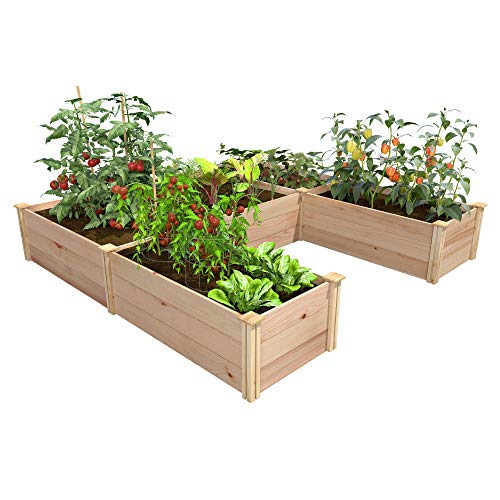
A U-shaped bed gives you the planting area of several separate beds while keeping every plant within reach from the central walkway. This one uses the same 3/4 in sanded boards and 2.5 in routed posts as the standard Greenes beds.
- Footprint: 8 x 8 ft overall. Height: 10.5 in.
- Boards: 3/4 in thick, 3.5 in tall. Open bottom.
- Wood: untreated cedar, made in the USA; species not named.
- Assembly: boards lock into routed posts; the listing says no tools are required.
Who it suits: Households that want one large, tidy vegetable plot and have a level area at least 8 ft square.
Who should skip it: Small yards, sloped sites and anyone who has not priced the soil. The seller does not publish the walkway width or soil volume, so check the listing diagram to be sure a wheelbarrow or kneeler fits.
Ownership notes: More corners mean more posts and more joints to keep square. Count the parts against the manual when the box arrives.
5. Greenes Fence Original Cedar Elevated Garden Bed, 48 x 24 x 31 in: best cedar bed on legs

For decks, patios and gardeners who cannot kneel, this is a cedar planter box raised to a 31 in working height. Iowa State University Extension puts comfortable tabletop gardens at 30 to 33 in to the top of the bed, so it sits inside that range.
- Overall size: 50.5 x 27 x 31 in. Inside bed: 47 x 23.75 x 9.6 in.
- Soil capacity: about 6.3 cu ft.
- Boards: listed as 3/4 in thick, 3.5 in tall, sanded North American cedar, untreated, made in the USA.
- Assembly: dovetail design; the listing calls for a rubber mallet. A fabric liner is included.
Who it suits: Herbs, salad greens, peppers and other shallow to medium-rooted crops on a hard surface.
Who should skip it: Anyone growing full-size tomatoes, carrots or potatoes, which want more than 9.6 in of soil, and anyone who needs wheelchair knee clearance, which this listing does not specify.
Ownership notes: An elevated bed dries out faster than a ground bed and its floor carries the full wet weight of the soil. Do not skip the liner, keep the legs off standing water, and plan to water more often in summer.
6. Greenes Fence Classic Cedar Raised Garden Bed, 4 x 8 ft: budget pick for short-term beds
The Classic line is the same dovetail design in 1/2 in American cedar. It is the low-cost way into a solid cedar 4 x 8, and the listing states the thinner boards plainly. Check that the title says 1/2 in before comparing.
- Footprint: 4 x 8 ft. Height: 10.5 in. Holds about 28 cu ft of soil per the listing.
- Boards: 1/2 in thick, untreated solid American cedar, no glue laminations.
- Assembly: boards slide into routed corner posts without tools. Open bottom.
Who it suits: Renters, school and community plots, and anyone trying raised beds for a few seasons before investing in something heavier.
Who should skip it: Anyone who wants a permanent bed. By our calculation above it has about a third less wall cedar than the 3/4 in version, and thin 8 ft boards are the most likely to bow outward under wet soil.
Ownership notes: If you buy it, drive a stake at the midpoint of each long side on the outside and keep soil an inch below the top edge. Treat it as a bed you will replace sooner than the others here.
7. Jumbl Raised Canadian Cedar Garden Bed, 72 x 23 x 30 in: longest elevated cedar planter
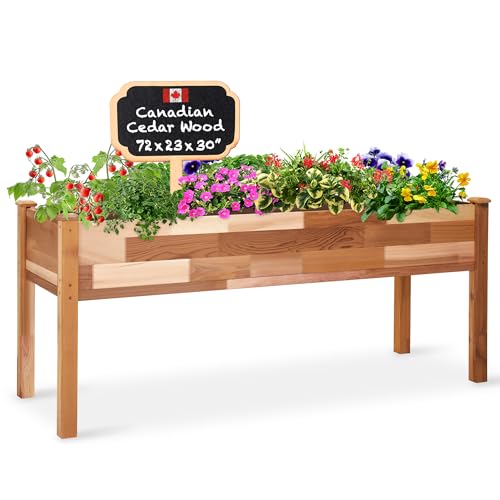
Jumbl’s elevated bed stretches the planter-on-legs idea to six feet, which suits a long railing or wall. It comes last because the maker publishes fewer specifications than the others.
- Overall size: 72 x 23 x 30 in, with integrated legs.
- Wood: Canadian cedar with a natural finish.
- Hardware and instructions included. Board thickness, soil depth, liner and load rating: not published on the pages we read.
Who it suits: Patio gardeners who want one long row of herbs, lettuces or flowers at standing height.
Who should skip it: Buyers who need to know board thickness before purchase, and anyone planning deep-rooted crops. Ask the seller for the inside depth first.
Ownership notes: A six-foot span of wet soil on legs is a heavy load. Check the leg bolts each spring, and add a liner if one is not in the box.
Which thickness for which bed? A simple decision rule
No extension service publishes a lifespan chart by board thickness, so treat this as a buying rule built from the sources above, not as measured data.
| Your plan | Minimum board to look for | Why |
|---|---|---|
| Trial bed, rental, up to about 11 in tall | 1/2 in | Lowest cost; accept a shorter life and brace the long sides |
| Standard backyard bed, 10 to 11 in tall | 11/16 to 3/4 in | The common kit standard; enough stiffness for a 4 ft side, watch the 8 ft sides |
| Bed you want to leave in place, or 14 in and taller | 1 in, bolted corners | Taller walls hold more soil pressure, and thicker boards take longer to rot through |
| Permanent bed, 18 in and taller | 1.5 in (2 x lumber), usually DIY | Beyond what most cedar kits offer |
If none of the rows fit, or you want the longest service life with the least upkeep, cedar may not be the right material. Coated steel does not rot. See our comparison of metal raised garden beds for that alternative.
How long do cedar raised beds last?
Published estimates for cedar range from at least 10 years to 10 to 20 years, and none of them come from controlled trials of thin-board kits. Gardenary groups cedar with redwood, cypress and hemlock at roughly 10 to 20 years and puts pine at about 5. Epic Gardening says most untreated cedar should last at least ten years.
For a measured comparison, Oregon State University Extension tracked untreated Douglas-fir beds built from 2 x 12 lumber. After six years more than half of the wood cross section on the inside lower half had decayed, and the beds were expected to need replacement (OSU Extension, EM 9879). It says cedar and redwood last longer, without giving a number.
Read those figures with the board in mind. The 10 to 20 year range is usually quoted by people building with 2 in lumber. A 1/2 in or 3/4 in kit board has far less wood to lose, so plan on the low end of the range or under it. Three things you control stretch it:
- Drainage under the frame. Gardenary notes that beds sitting on wet lawn or soil decay faster than beds on level gravel or stone. Our page on what to put on the bottom of a raised garden bed covers base options.
- Heartwood content. Set aside boards with wide pale sapwood bands for the top course, where they stay drier.
- Replacing boards one at a time. With sliding or bolted kits, swap the bottom course when it softens instead of replacing the bed.
Who should not buy a cedar kit
- Gardeners in very wet, humid climates who want a bed to last a decade or more with no maintenance. Wood of any species decays faster there.
- Anyone who needs walls taller than about 18 in. Thin kit boards are a poor fit for that soil load; look at thick lumber or metal.
- People with a saw, a drill and a lumberyard nearby. Building from 2 x 6 cedar gives you 1.5 in walls that no kit on this page matches.
Cedar raised bed FAQ
Is cedar good for raised garden beds?
Yes. University extension guides, including Iowa State, recommend decay-resistant wood such as cedar or redwood for permanent bed walls. Cedar needs no chemical treatment and is light enough to ship as a kit. Its weak point is cost, which is why many kits use thin boards.
How many years will a cedar raised bed last?
Gardening sources quote at least 10 years and up to 20 for cedar, mostly for beds built with thick lumber. For kits with 1/2 in to 3/4 in boards, expect the lower end or less, depending on drainage, climate and how much sapwood the boards contain.
Is untreated cedar safe for growing vegetables?
Yes. Untreated cedar has no added preservatives, and all seven kits here are sold untreated. Oregon State University Extension lists cedar among the alternatives for gardeners who prefer to avoid treated lumber.
Should you seal or line a cedar raised bed?
It is optional. University of Georgia Extension says linseed and tung oil have not been thoroughly shown to extend the life of wood in soil contact. If you seal, do the outside faces for appearance. Elevated beds are the exception for liners: use the fabric liner so soil stays in and the floor boards drain.
Are cedar raised beds worth it over cheaper wooden raised beds?
They are if the bed will stay in place for several years and the kit states real cedar with a board thickness of 3/4 in or more. Fir and pine wooden raised beds cost less but break down faster; the Oregon State trial found untreated Douglas-fir ready for replacement after six seasons.
Bottom line
There is no single winner, because the right cedar bed depends on how long you want it to last and how deep you need it. For a standard 4 x 8 vegetable bed, the Greenes Fence Premium Cedar kit balances board thickness with tool-free assembly. For a bed you intend to keep, the 1 in boards of the Infinite Cedar Premium are the strongest specification we found in a kit. Choose the 17.5 in Infinite Cedar Select for depth, the Greenes elevated bed for patios, and the 1/2 in Classic only if you accept a short service life. Check every listing for species, thickness and height before ordering.